Oseledets: A Modern Reading of the Cossack Haircut
What the oseledets is and where the Cossack tradition began
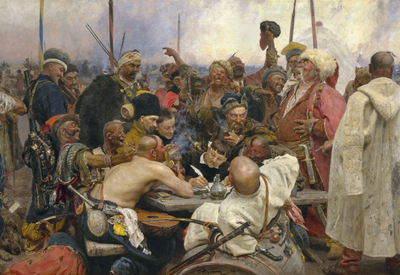
The oseledets is a long lock of hair left on a shaved or very closely cropped head, usually growing from the crown and either tucked behind the ear or left loose. The style is older than the Cossacks themselves — similar cuts are recorded among the steppe nomadic cultures — but it entered Ukrainian tradition as the mark of a warrior of the Zaporozhian Sich. The most famous depiction is Ilya Repin's painting Reply of the Zaporozhian Cossacks, where nearly every second figure wears one, and that is where most Ukrainians know it from. The practical logic behind it was entirely down to earth: a shaved head on campaign meant fewer lice, easier hygiene, and nothing for an enemy to grab hold of in a fight. The lock stayed as a sign of belonging, and the higher the status, the better groomed it was. After the Sich was dissolved the oseledets almost vanished from daily life and became a historical symbol worn at re-enactments, in theatre, in folk ensembles. Its return began after 2014 and accelerated sharply after 2022, when some soldiers started wearing it deliberately as a marker of continuity. By 2026 the cut has moved well beyond the army: civilian men of all ages ask for it, and not as a costume — they want to wear something of their own rather than something borrowed from a New York or London lookbook.
The modern reading: a fade, a long forelock and balance
A historically accurate oseledets looks severe in city life, so in the barber's chair it is almost always adapted. The modern reading rests on three decisions. The first is replacing a fully shaved side with a fade. Instead of bare skin we build a gradient from zero or one up to a three, and the head stops looking like a re-enactment while staying clearly short. The second is the length and placement of the lock. The historical version grew from the crown; the modern one is usually shifted slightly forward into the frontal zone and left long enough to sweep back or to the side. That way the cut reads either as an oseledets or as a long top on short sides, depending on how you style it. The third is the outline. A clean line at the temples and nape is exactly what separates a considered cut from one done at home with clippers. We usually keep a soft, slightly rounded outline — a hard line combined with a long lock tips the whole thing into theatre. Proportion deserves its own note. The thicker and longer the forelock, the softer the transition on the sides needs to be, otherwise the head narrows visually. Slim men with long faces are better served by a shorter forelock and a higher fade; broader faces want the opposite, a longer lock and a lower transition.
Who it suits and how to wear an oseledets daily in 2026
The first question men ask before their first oseledets is whether it will look strange at work. The honest answer depends on the length of the lock and on how much styling you are willing to do. The short version, where the forelock is no more than ten to twelve centimetres, reads as an ordinary short cut with a long top once it is swept back, and raises no eyebrows in an office. The long version, visible even at rest, is a deliberate statement and you should be ready for that. Maintenance is simple but not free: the sides grow out fast, and without a refresh every two or three weeks the fade blurs and the neatness of the shape goes with it. The lock itself is cut rarely — every two or three months, just to remove split ends. For styling, a matte paste or a sea-salt spray is enough; glossy gels make the forelock look glued on. If your hair is wavy the oseledets actually looks better than it does on straight hair, because the texture gives volume without any styling at all. One last piece of advice: do not come in for an oseledets holding a Repin painting. Come in knowing how much you are prepared to carry on your head every day, and we will settle the historical part in five minutes of conversation in the chair.