How to Cut Your Own Hair With Clippers at Home, Step by Step
Which guard number should you start with?
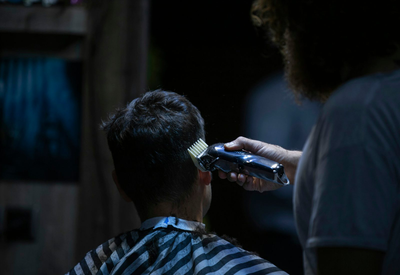
You can, as long as you pick one guard and take your time. Clippers forgive a long guard and punish a short one, so start longer than you think you need. On most sets a number 1 leaves about 3 mm, a number 2 about 6 mm, a number 3 about 10 mm and a number 4 about 13 mm, though brands differ slightly, so read the size printed on the guard itself. For a first home cut, use a 3 or a 4 all over. You can always go one number down later, but nobody has found a way to put hair back. Work on dry hair. Wet hair clumps, lies flat and looks shorter than it is, so you end up taking off more than you meant to. Comb it up and outward first, then check the clippers: clean blades, the guard clicked on fully, a towel round your shoulders. Sit in good light. Comb through every few strokes, because clumped strands get cut unevenly and leave patches you only notice later. Start at the sides above the ear and move the clippers upward, against the direction of growth, in slow strokes about a hand wide. At the end of each stroke tilt the clippers away from the head instead of dragging them off sideways, which leaves a step. Finish one side, then the other, and compare them in the mirror before you touch the top. One pass, a pause to look, the next pass. Rushing is how most home cuts go wrong.
The back of your head needs two mirrors and slow hands
The back is where home cuts fail, because you cannot see it. Stand with your back to a large mirror and hold a hand mirror in front of your face, tilting it until the reflection of your nape appears. Practise moving your hand without the clippers first. Everything is reversed in the glass, and your hand will head the wrong way a couple of times before it learns. Work upward from the neckline with the same guard as the sides, in short strokes, keeping the clippers flat so the guard follows the curve of the skull. Below the crown the head turns inward, so tilt the blade slightly there. Do not chase a hard edge on the neckline: a crooked sharp line shows from behind at once, while a soft taper hides its own wobble. For the top, use a longer guard, such as a number 6, which leaves about 19 mm, and run the clippers from the forehead back. Do not push the clippers into the head: they cut on their own, and pressure only drags. A phone photo of the back also shows unevenness better than the mirror does. Then blend. Move up one guard, so a 4 after a 3, and pass it over the top edge of the sides where short hair meets long, flicking the clippers away from the head at the end of each stroke. Go over each area twice from different directions and check with your fingertips, because a ridge you can feel will show in the light. Blending is mostly patience, and one extra pass costs less than a mistake.
Stop before the fade and let a barber take over
Know where to stop. A skin fade, a taper that drops to bare skin, a sharp outline around the ears and a hard parting all need an open blade, a steady angle and a view of the head from behind. A home set with a guard cannot produce a smooth fade. If the back has come out uneven, do not chase it with more passes: each fix removes a little more and the gap grows. Stop and book in, because a barber can match everything to the shortest patch, and a slightly uneven cut is far easier to repair than a ruined one. Check the result the next morning in daylight, at arm's length, before you decide anything needs fixing, since a bathroom lamp hides what the day shows at once. The whorl at the crown needs a mention too: hair there grows in several directions, and without a view from above it is easy to leave a patch that only other people notice. Afterwards brush the hair off your neck, clean the blades with the little brush and oil them if the manual says so. At 044 Barbershop in Kyiv a machine haircut means two guard lengths plus an edged or faded outline, which is the part that is hardest to do on yourself. Cut at home in the weeks between visits, and come in to us when you want the back and the fade checked from behind, where you cannot see them.