Skin Fade: What It Is, Who It Suits and How Long It Lasts
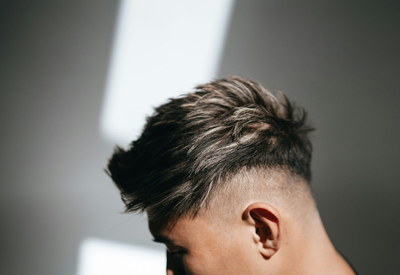
What makes a skin fade different from a regular fade?
A skin fade is a fade whose bottom band goes all the way down to bare skin. A regular fade stops at the shortest guard or at the clipper with no guard, which leaves a dark shadow above the ears. For a skin fade the barber finishes the bottom with a foil shaver, a trimmer with its blade set to zero or a straight razor, so the skin there is smooth. Bald fade is another name for the same cut. Between the two sits the zero fade: a clipper with the lever closed leaves under a millimetre, about 0.5 to 1 mm, which reads as a light haze on dark hair and grows out more softly. Clients often say "down to zero" when they mean skin, while the barber hears a clipper with no guard, so name the tool instead: the shaver or the closed blade. On fair hair the gap between zero and skin is hard to see, while dark hair on pale skin shows it from across the room. Height works as it does in any fade. A low skin fade shows skin only above the ear and at the nape, a mid one takes it up to the temples, and a high skin fade leaves almost the whole side smooth, with hair starting where the head turns onto the top. The higher the skin goes, the sharper the contrast with the top and the more of your head is on show, bumps and dips included. So the first thing to settle in the chair is how much skin you are happy to show, and the length on top comes after that.
Your nape decides whether bare skin is a good idea
The cut suits a head with a smooth, even back and skin that takes a close shave without complaint. Coarse dark hair against pale skin gives the strongest contrast, and curly hair holds a crisp line above the blend. Four things are worth a second thought. First, bumps. The British Association of Dermatologists explains that hair cut too short can slip back below the surface and grow into the skin, which happens more with coarse, curly hair. The American Academy of Dermatology describes acne keloidalis nuchae, firm itchy bumps on the back of the neck that can appear hours or days after a close-shave haircut, and advises haircuts that avoid shaving that area. If your nape already reacts like this, a zero or a few millimetres at the bottom is the safer finish. Second, scars and dents, which bare skin shows plainly. Third, a strong cowlick at the nape. Hair there grows in a swirl and the stubble comes back patchy within days, so barbers often keep the skin on the sides and leave the nape tapered. Fourth, the Kyiv winter. A bare nape under a coat collar or scarf in frost gets cold, and the same academy lists collars and helmets among the things that irritate that skin. At 044 Barbershop in Kyiv we suggest starting with a zero fade if your skin goes red after every haircut, then going down to skin next time if it stayed calm.
Point to the spot where the skin should start
Scalp hair grows about 0.35 mm a day, roughly a centimetre a month, so by the third day bare skin carries a millimetre of stubble and the sharp edge turns into a shadow. A skin fade looks sharpest for one to two weeks, and men who keep one usually refresh it every one to two weeks; past that it reads as an ordinary short fade. When you ask for one, give the barber four answers. Where the skin starts: touch the spot on your own head, above the ear, at the temple or higher. What stays on top, in centimetres or as a scissor length. Whether the nape is tapered, with skin on the sides only, or faded all the way round. And whether the edges get a sharp line-up or stay natural, since a drawn line is the first thing to show regrowth. Between visits, leave the bottom to the barber: without a mirror behind you the blend line slips within a minute, and fixing it means taking the skin higher. Bare skin needs looking after too. In summer it burns as easily as your forehead, and the AAD advice for an uncovered scalp is a broad-spectrum sunscreen of SPF 30 or higher, reapplied every two hours and after sweating, or a hat. Leave the stubble alone when it itches, and if bumps keep returning after haircuts or start to bleed, show them to a dermatologist before the next fade. Come in and the barber will trace the line with a finger where the skin would start, so you can check it from the side and the back before the first pass of the shaver.