Beard fade: how a barber blends the haircut into the beard
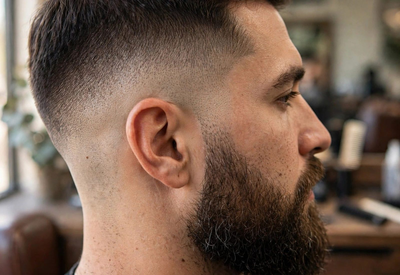
What is a beard fade, and what does it fix?
A beard fade is hair that gets gradually shorter from the fuller part of the beard, up the cheek and into the sideburn, with no visible step. It usually continues a fade on the temples: the haircut runs down to skin or about a millimetre, and the beard picks up length just as smoothly on the way down. Barbers often see the opposite in the chair. The temples are freshly taken close, a beard two centimetres long starts straight below them, and a hard line sits between the two as if the head came from two different photographs. The blend removes that line. Your beard keeps its own shape, since the fade hardly touches the chin and jaw and works mostly on the upper third of the cheek and the sideburns, so it suits a few millimetres of stubble as well as a long beard. It also differs from a neckline or cheek line, which are edges, whereas a fade is a change in length. They often go together, but a crisp edge with no blend still leaves the haircut and beard looking separate. A short faded beard can also read tidier on cheeks where the hair grows thinly, because the length there is small anyway and the gaps show less. That is often the first reason a man with a patchy cheek asks for one. It takes nothing off the chin, so there is little to lose by trying it.
The barber builds it from the temple down
The job usually starts with the haircut, because the barber needs the shortest length on the temple to set the start of the blend. The sideburn then comes down with the same guard, often around 1 mm, and each section below it gets a little more length. Three or four steps are usually enough on a cheek, and the barber rubs out each line between them with the corner of the clipper or a trimmer, using short flicks away from the skin. Symmetry gets checked against the ears, cheekbones and jawline. Faces are rarely even, so a good barber looks from the front in the mirror as well as from the side. Beard hair often grows at several angles, which is why the clipper moves against the growth on the cheek and more carefully near the corner of the jaw, where it is easy to take too much. At 044 Barbershop in Kyiv you can book this along with the cut as a haircut and beard trim, so one person handles the fade on the head and the blend on the beard in one sitting. Tell the barber three things in the chair: how short the sideburn should go, where on the cheek the blend should end, and what length to keep on the chin. If you are growing the beard out, say so first, or you may lose the millimetres you spent a month collecting. A photo of a beard you like settles the rest quickly.
Try it at home without eating into the cheek
You can try one at home if your trimmer has several clear length settings and you have good light and a second mirror. Good light matters more than an expensive trimmer. Start by trimming the whole beard to its main length. Drop one setting and go over the upper cheek only, then drop one more and do the sideburn only, keeping each band narrower than the last and softening the line between them with the corner of the blade. The usual mistake is to begin low and climb too high, so the fade swallows half the cheek, and only time puts that hair back. A home tidy holds the shape for a few days, but it does not replace the visit, because you cannot see the join with your haircut properly in your own mirror. Beard hair grows about 0.3 to 0.5 mm a day, so two or three millimetres a week, which is plenty to matter here: the blurred zone on the sideburn turns into a visible step within a week or two. Barbers therefore recommend refreshing a beard fade every one to two weeks, together with the haircut. Keep the top of the cheek short between visits and leave the jaw alone, since that is where a home mistake shows longest. Come in if you want temple, cheek and beard to read as one line: the barber sees both sides at once and evens out the blend where your bathroom mirror cannot.