What to Ask the Barber for a Beard Trim, in Plain Words
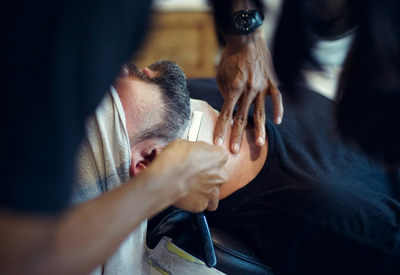
How long should it be, and where on the beard?
Give the barber three things: how long to leave the beard, where the edges go, and whether it joins the sideburns. Length goes wrong most often, because 'a bit shorter' means the cheeks to one man and the chin to another, so name a number. Guards carry millimetres or a number depending on the brand, and Wahl, for one, lists its No. 1 at 3 mm, its No. 2 at 6 mm and its No. 3 at 9 mm, so say 'six millimetres' rather than 'a two' when you know it. If you do not know it, say how much you want to lose compared with today, or say 'same length, just tidied'. A pinch of hair at the chin between two fingers also works: it shows the length you mean faster than any figure. Then say whether the length is level all over or heavier at the chin, since a beard cut level looks different from one that keeps weight below the jaw. Next come the sideburns. The beard can fade into them, stepping down gradually towards the ear until it meets the length of your haircut, which Wahl does with adjustable guards, or it can stop at a clean gap. Say 'blend it into the fade' or 'leave a gap', and point to where the beard should end. The ear is where the misunderstandings happen, and a finger on your own face settles it in a second. In the chair, 'just tidy it up' is the request barbers hear most often, and it can mean two different jobs: the edges only, or the length as well.
Point to the neckline, the cheek line and the lip line
The edges give a beard its shape, and each one has a word you can borrow. The neckline is the lower border under the chin. Philips and Wahl both place it with a finger laid flat just above the Adam's apple, so 'a finger above the Adam's apple' is a clearer request than 'not too high'. If you are unsure, Wahl advises starting lower than you think, because you can always trim more later. The cheek line is the upper border. Philips offers two options: keep the natural line if it already looks clean, or have a straight or slightly rounded line run down to the bottom of the sideburns, and it notes that the lower the cheek line sits, the longer the face looks. So ask for 'natural' or 'crisp', and say whether you want it high. The lip line is the third: the moustache can be left over the lip, or trimmed back to leave a clear gap of about a millimetre above it, which Philips calls optional. 'Moustache off the lip' is the whole sentence. Length is a separate question: Philips suggests matching the moustache to the beard or leaving it slightly longer so it stands out. At 044 Barbershop in Kyiv a beard trim is modelling plus a dry or hot-towel shave, so it also helps to say how hard you want the edge: a sharp border that shows every day, or a softer one that grows out gently. Most beards grow thicker on one cheek than the other, and a barber sets the two lines against each other by where the hair actually lies, not by the picture.
A bad home trim: what a barber can fix and what not
Yes, a barber can usually fix a beard after a home trim, with one limit: hair cannot be added back. The barber finds the shortest spot and brings the rest down to meet it. A hollow on one cheek, a step above the ear or a neckline set too high becomes the new reference, and the beard is blended around it. That is why a repair ends up shorter than the beard you wanted, and why it is better to hear so before the clippers start. Say what you do not want touched as well: if the moustache came out well, it stays, and the barber works only around the problem spot. Tell the barber what you were aiming for and what you did, in the same plain words: 'I tried the third comb, then went one shorter on the left'. A photo of the beard you wanted, and one from before the home attempt, shows where the length was meant to sit. Ask directly whether to even it up now or let it grow a little first, because sometimes the honest answer is the second. Until the visit, leave it alone: every attempt to level it takes off another millimetre. The chair gives you what the bathroom mirror does not, with both cheek lines set against each other and the neckline placed for your jaw. Come in with the beard as it is and start with the lines: the barber can set them level, then finish with a dry or hot-towel shave.