Cowlicks and Double Crowns: Cutting Hair That Grows Its Own Way
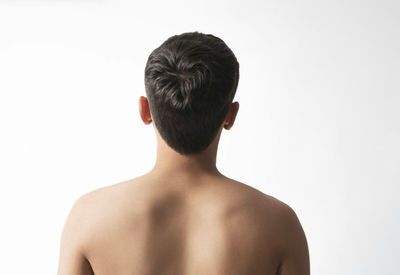
The whorl at the crown and the cowlick over your forehead
Hair grows out of the scalp at an angle, and the follicles set that direction before you are born. At the crown the hair grows in a spiral called the whorl, and in most people it turns clockwise. The whorl stays with you for life and shows more once the hair around it starts to thin. Some men have two whorls side by side, a double crown, and the hair between them splits into a parting of its own. A cowlick is a patch of hair growing against the rest. You usually find it at the front hairline, where it lifts the fringe, and sometimes at the crown or the nape, where short hair lies sideways. You cannot retrain a follicle. Years of combing, sleeping in a hat or gelling it down every morning leave the angle where it was, and a barber who promises a permanent fix is telling you a fairy tale. A good barber reads the growth pattern and builds the haircut around it. Before the first cut, the barber looks at your hair dry, combs it in several directions and watches where it falls back. Water weighs hair down and hides the pattern, so a barber who wets your head first starts the cut blind. Two clients can bring the same photo and leave with different cuts: one gets the parting on the left, the other on the right, because the cowlick pushes the hair to one side. Your barber should tell you this in the chair, before the clippers come out.
The awkward length at which hair starts standing straight up
A whorl causes trouble at one particular length. Very short hair, up to about a centimetre, lies close to the scalp whatever its direction, and the spiral shows only as a pattern. Long hair has enough weight to fall and cover the spot. Trouble starts in between, somewhere from two to six centimetres: the hair is long enough to show its direction and too light to lie flat, so it stands up like a brush at the crown or lifts the fringe into a peak. You know the effect if a cut looked fine for two weeks and then a tuft at the back started sticking up every morning. The first decision, then, is the length on the problem zone. Either you go short there, with a crop or a fade that runs through the crown, or you keep enough length and weight for gravity to win. Going short means a visit every three to four weeks: hair grows about a centimetre a month and soon reaches the awkward range again. The second option takes patience and a barber who will not thin the area out. Texturising scissors leave short hairs inside the mass, and those short hairs prop up the rest. A double crown follows the same rule with higher stakes, because the two spirals push the hair in opposite directions and open a gap between them. On a double crown we usually leave the zone a centimetre longer than the rest of the top.
Cutting with the growth pattern and styling it at home
In the chair, show the barber where your hair misbehaves, even if it lies flat that day. The barber cuts that zone following the spiral, leaves a little extra length over the whorl so the hair covers it, and puts the parting where the hair splits by itself. A front cowlick rules out a heavy straight fringe, but it gives you free lift for a quiff or a textured fringe swept to the side it already pushes towards. At the nape, a whorl that grows sideways looks better with a tapered or rounded neckline, since a sharp block line shows every change of direction. At home the fix starts at the root. Wetting the ends in the morning changes nothing, so soak the hair down to the scalp, then blow-dry the zone against the growth first and with it second, pointing the nozzle down the hair shaft and holding the hair flat with a comb or your palm. Once the root cools, it holds the direction you gave it, and the cool-shot button on the dryer speeds that up. With a double crown, start with the strip between the two whorls: dry it and hold it flat with your palm until it cools. Finish with a matte paste or clay warmed in your palms and pressed into the zone without raking. Gel and glossy pomade glue the hair into strands and open the scalp at the whorl. Before you leave, ask the barber for a hand mirror and check the crown from behind.