How to Blow-Dry Men's Hair for Volume Without Frying It
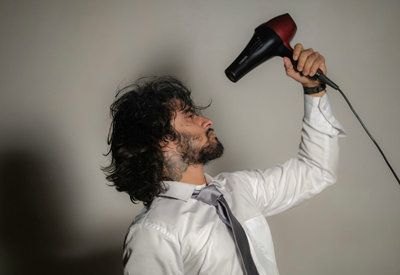
How wet should hair be before the dryer comes out?
Blow-dry a man's hair for volume in this order: towel-dry it until it is damp, set the dryer to medium heat, dry the roots against the direction they normally lie, dry the same area again in the direction you want it to sit, and finish with a burst of cold air. Volume lives in the roots, and hair tends to dry in the shape it is held in as the water leaves. Roots that dry flat against the scalp stay flat, which is why a quiff styled on soaking hair has collapsed by lunchtime and no amount of product brings it back. So begin with damp, not dripping, hair. Press the water out with a towel rather than rubbing, because the American Academy of Dermatology warns that rough rubbing can damage hair, and keep the brush away from hair that is still soaked, since hair is delicate when wet. A few passes of the towel and a few minutes of waiting do half the job, and the dryer only has to finish it. Then fit the narrow nozzle that comes with most dryers, the concentrator, so the air goes where your fingers or a small vented brush point it. Hair under about four centimetres needs fingers only: push the roots up and back and keep the airflow on them. From five centimetres a brush helps, lifting each section away from the scalp while the air runs along it from root to tip. Start at the crown and work towards the forehead, because volume shows on top and the sides can be dried downwards at the end.
Medium heat and 15 centimetres of distance protect the hair
Heat is the part to take seriously. The American Academy of Dermatology says excessive heat can damage hair of any type, and advises limiting blow-drying, choosing low or medium heat and using a product that protects hair from the heat. A 2011 study in the Annals of Dermatology tested distance. Researchers dried hair tresses repeatedly with a dryer held 15, 10 and 5 centimetres away and compared them with tresses left to dry in the air. At 5 centimetres the air measured about 95 °C and the hair surface suffered most. At 15 centimetres with the dryer kept moving, the hair came out less damaged overall than air-dried hair, although its surface still showed more wear than with no dryer at all. The practical reading is a hand's length between nozzle and head, a dryer that never rests on one spot, and the hottest button left alone. It is one laboratory study on tresses, so take it as a reason for care, not a licence to dry on full power every day. The mistake barbers see most often in the chair is a man who dries only the fringe, the part the mirror shows him, and leaves the back and the nape damp. The front stands up, the back lies flat, and the head looks as if two haircuts were fitted together. At 044 Barbershop in Kyiv we offer styling, a wash and style, and the barber can show you where to hold the dryer on the parts of your head you never see.
Lift the roots against the grain, then lock them with cold air
Work in sections. Dry the crown first, then the sides, with the nozzle pointing down the hair so the air runs from root to tip and smooths the surface, and leave the fringe for last, lifting it up and slightly back for a quiff or forward for a textured crop. Every section gets two passes: first against the direction of growth to stand the roots up, then with it so the hair settles into the shape you want. Hold the lift for a few seconds, then press the cool button while the hair is still in your fingers or on the brush. Philips presents the cold setting as the last step that fixes the style, and it takes about ten seconds. Stop when the roots are dry. Chasing the last damp from the ends is where heat does its harm. Curly hair does better with a diffuser, which spreads the air softly: cup the hair in your hand, dry it, and keep your fingers out until it is dry, because touching it halfway tends to break the curl into frizz. Product comes after the dryer. A pea of clay or paste warmed in the palms gives grip to the volume you built, whereas a heavy pomade pressed on top flattens it. If the crown still refuses to rise, the cause is often the cut: hair that is too short or too even has nothing to stand on. Come in for a wash and style and look at the angle the dryer takes at your own crown, the one you cannot see in the bathroom mirror.