From Tsyrulnyk to Barber: A History of Ukrainian Barbering
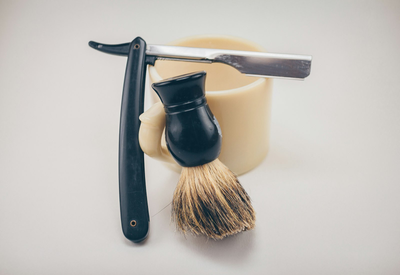
Barber guilds: when your barber was also the city surgeon
The Ukrainian word tsyrulnyk came from Latin via Polish and described a man who cut hair, shaved faces and — which sounds absurd today — practised medicine. In the towns of the Polish-Lithuanian Commonwealth, which covered much of what is now Ukraine, these barbers organised into guilds with their own statutes, apprenticeships and quality marks. The tsyrulnyk pulled teeth, let blood, applied leeches, set dislocations and dressed wounds: anything that required a sharp blade and a steady hand belonged to him. Surgery at the time was considered a craft rather than a science, and university physicians would not stoop to it. The famous striped pole outside the door — the red and white one still standing outside barbershops today — was never decoration. It was signage: red for blood, white for the bandage. In Lviv, Kyiv and Kamianets these guilds existed for centuries and formed part of the urban artisan elite. The separation came only in the eighteenth and nineteenth centuries, when medicine finally claimed the scalpel and left the barber the razor. That is when the profession narrowed into what it is now, and also when it began losing the standing it had held for several hundred years.
The Soviet salon and the loss of a men's craft in Ukraine
The Soviet period turned a men's haircut into a service rather than a craft. Private shops were closed and masters were folded into state salons with output quotas, fixed price lists and queues. A haircut cost pennies, took ten minutes and followed one of a handful of approved patterns. Choosing a shape to suit a man's face was not part of the conversation — not for lack of talent among the barbers, but because of how the system was built, where speed counted for more than the result. Straight-razor shaving survived, but narrowed to a small circle of old-school masters. More importantly, the culture of returning to your own barber disappeared. You did not go to a person, you went to the salon nearest your flat, and the queue decided who cut your hair. The nineties added chaos on top: the state system collapsed and the salons that replaced it were aimed primarily at women, leaving men to choose between a cheap neighbourhood hairdresser and nothing at all. An entire generation of Ukrainian men grew up believing a haircut was household maintenance rather than part of how you look and how you feel.
The barbershops of the 2010s and where the craft is in 2026
Barbershops returned to Ukraine around 2013 to 2015, and at first they looked like an import: exposed brick, beards, whisky, a borrowed American aesthetic from the twenties. That worked as marketing, but the real change was not in the interior. For the first time in decades a man had somewhere he was cut for longer than ten minutes, asked about his hair growth patterns, and booked with a specific master. What the Soviet salon had removed came back: a personal relationship with your barber. The second stage arrived when the decor started to wear thin. From roughly 2019 the focus shifted from atmosphere to technique — the quality of the fade, scissor work, shaving, knowing what to do with thinning hair or a curly texture. After 2022 came a third, much quieter shift. The barbershop became a place where a man sits down and gets forty minutes of something predictable and controlled, which is a rare resource in a country where very little can be planned. It is no longer about whisky or brickwork. It is about a craft that existed in Ukrainian towns for centuries, disappeared for seventy years, and came back in a form close to the one it started in: a master, a blade, a chair, and a man who comes specifically to him.