High Fade, Low Taper or Undercut: Which One Do You Mean?
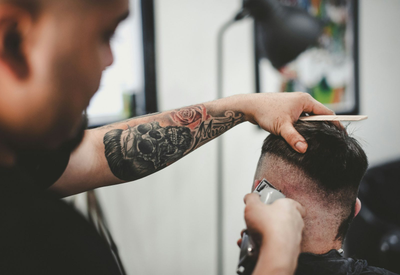
How high do the clipped sides go on a high or low fade?
Boks and poluboks are what many men still call two short clipper cuts, and in barbershop terms they differ in one line: how high the fade or taper climbs the sides. A boks is a high fade or high taper, with the short part cutting the top off from the temples and the back of the head, while a poluboks, literally "half-box", is a low or mid taper that keeps the clipper line lower, from the top of one ear under the bump at the back of the skull to the other ear, and leaves more length on top. Old textbooks describe the poluboks as a gradual blend with a longer top than the boks, and the exact numbers vary by author. The kanadka is a different idea. One Ukrainian barbershop chain describes volume at the forehead and crown over short-clipped temples and back, joined to the top by a smooth transition. Why Canadian? The Ukrainian academic dictionary knows kanadka only as a Canadian woman, and the barbershop stories about a ship's rope or Canadian hockey players cite no source, so any of them is a guess. The undercut is the only one of the four with an English name, and the only one with no blend at all: the sides and back are cut to one short length and the long top hangs over them. It was common among young working-class men in the early twentieth century and came back in the early 2010s.
A crew cut keeps a blend; an undercut leaves a hard step
In the words a Kyiv barber uses today, a boks is a high fade or a high taper under a short top, and once the sides go to bare skin it sits close to the American military high and tight. A poluboks is a low or mid taper with a longer top, which turns into a low or mid fade if the bottom goes down to skin. The kanadka maps onto the crew cut, whose top is graduated from the longest hair at the front hairline to the shortest at the back of the crown; its longer version is called an Ivy League. The undercut keeps its name. The old textbooks add one detail that still matters in the chair. The height of the line depends on the shape of the back of your head: a prominent bump can be hidden by taking the line under it, so barbers usually run their fingers over the skull before choosing where the short part ends. At 044 Barbershop in Kyiv the closest service to a boks or a poluboks is the machine haircut, two guard lengths plus an edged or faded outline, so the old name sets where the outline sits and the guards set how short it goes. The names are older than barbershops: the same dictionary lists boks as a men's haircut, and cites Ostap Vyshnya's line "cut under a boks, with a cigarette in his mouth".
Ask for a fade height, a guard number and a top length
Treat the old name as a starting point, then turn it into three answers. First, where the short part ends: by the top of the ear, under the bump at the back, at the temple, or higher up where the side of the head turns into the top. Second, how short it goes at the bottom, down to skin or on a guard, with the number if you know it, since a poluboks on a guard grows out as a shadow while a skin version shows a stripe within days. Third, the top: its length in centimetres or fingers, and whether it stays even or rises toward the forehead, which is exactly what separates a plain short top from a kanadka. Add one word about the join. A blend gives you a boks, a poluboks or a kanadka, and a hard step with no blend is an undercut. Barbers often hear poluboks used for anything from a soft taper to a mid fade, so the word alone rarely settles the cut. The same three answers work for a boy, and there a poluboks on a guard is the forgiving choice for a school term, because it has no hard line to grow out. Children's haircuts are on our list as well. If you remember the cut from an old photo, bring it: the side view shows the height of the line better than any name. Say the old name in the chair, and the barber can trace with a finger where its line would run on your own head before the clipper starts.