Crew Cut, Butch and Flat Top: How the Three Cuts Differ
How many millimetres does each cut leave on top?
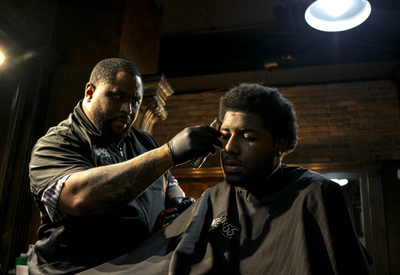
A butch, a crew cut and a flat top are all short clipper cuts with the hair on top standing upright over tapered sides, and they differ in the shape of that top. A butch keeps one even length across the top and the upper sides, following the round of the head; English Wikipedia files it under the brush cut, its formal name, at 6 to 13 mm, and barbering guides usually name a number 3 or 4 guard, which is 10 or 13 mm. A crew cut grades the top from its longest at the front hairline to its shortest at the back of the crown, so in profile the outline runs close to horizontal: a short crew is about 19 mm at the front and 6 mm at the crown, a long one about 38 mm down to 13 mm. A flat top is a crew cut whose top reads flat from the front as well as from the side. In its classic form it leaves about 6 mm at the highest point of the head and 19 to 32 mm at the front, depending on how round the skull is, over sides of about 6 mm. If you grew up with salon names, the same cuts went by other words. Ukrainian Wikipedia's list of haircuts equates the yizhak, or hedgehog, with the butch cut and the maidanchyk with the flat top, which it calls a variant of the hedgehog, while the Ukrainian academic dictionary explains "under a bobryk" only as a very short men's cut. Shops still draw the lines differently, and one barber's butch is another's long buzz, so the millimetres tell you more than the name.
A flat top stands only on dense hair that grows straight up
The sides decide how sharp each cut looks. Classic barbering texts cited by Wikipedia taper a crew cut short, semi-short or medium at the sides, and current guides pair it with anything from a soft taper to a skin fade. A butch usually keeps the sides on the same guard as the top or one shorter, with a tapered neckline. A flat top goes tighter: the lower two-thirds of the sides and back are clipped at 6 mm or less, and the upper third is boxed in clipper over comb, with the comb held upright against the side of the head so the corners stand square instead of following the skull. The top is cut clipper over comb too, and some barbers use a wide flat-top comb, about 10 cm across, to keep the deck level. A crew cut likes thick hair that stands up readily, though on a well-shaped head it works on fairly fine hair too. A flat top needs dense, coarse hair that stands on its own: the Canadian barbershop Markcutit says fine or soft hair flops and the deck collapses by midday, and names thinning at the crown and a strong double crown as hard cases. On some heads the scalp shows through the centre of the deck, a patch barbers call the landing strip. A butch shows the head as it is, so bumps and a flat back of the head are visible from a number 3. At 044 Barbershop in Kyiv a butch fits the machine haircut on our list, with two guard lengths and a faded outline: one guard for the top and a shorter one for the sides.
Order it in parts: guard numbers, fade height, top shape
Short cuts lose their shape fast. A flat top grows out of its precise line within days; Wikipedia puts maintenance cuts at every two to three weeks and some wearers visit weekly. Grooming guides give a crew cut three to four weeks between full cuts, with the sides refreshed every two or three, and a butch three to four weeks too, nearer two or three on the shorter guards. A butch needs nothing after washing. A crew cut takes a little matte product pushed up from the crown towards the front. A flat top is blow-dried upwards and fixed with wax, gel or spray, though some especially coarse hair holds the deck with no product at all. When you order, give the parts rather than the name. For a butch: a number 4, 13 mm, on top following the shape of the head, a number 3 on the sides and a tapered neckline. For a crew cut: a taper or a low, mid or skin fade on the sides, about 19 mm at the front grading to 6 mm at the crown, and whether the front brushes up or forward. For a flat top: how high the front stands, whether the deck runs level or slopes up or down from the forehead, square or rounded corners, and whether you mind a landing strip. Bring a photo from the side and one from the front, since a crew and a flat top look alike in profile. Come in with the top a little longer than you want, and the barber can stand it up dry, see how it grows at the crown and set the grade or the deck to the shape of your head.