Undercut Haircut: What It Is and How to Ask for One
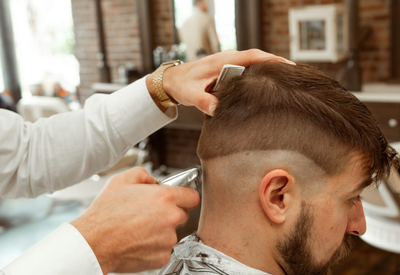
Disconnected or faded: which undercut do you mean?
An undercut is a men's haircut with the sides and back cut short, usually to one clipper length or to the skin, and the top left long, with no blend between the two zones. The long hair falls over the short sides, so the cut reads as two layers with a step where they meet. The name is English, and Ukrainian Wikipedia translates it as 'undercutting'. The style is over a century old. English Wikipedia dates its fashion to the 1910s to 1940s, and the cut is often linked to poverty, since a barber skilled enough to blend the sides cost money. Around the turn of the 20th century and until the 1920s it was worn by young working-class men, especially street gangs. It was out of fashion for decades, returned in the 1980s and became fully fashionable again in the 2010s. Barbers now cut it two ways. A disconnected undercut keeps the sides at one length right up to a hard line, so the top hangs over a visible shelf. A faded undercut grades the sides from the skin at the bottom up to that line, which softens them while the top still stands apart. Both differ from an ordinary fade, where the gradient runs into the top and nothing overhangs. So when you say 'undercut' in the chair, add which of the two you want and how short the sides go. Most often the sides go to a short guard of a few millimetres, down to skin for a harder look or a little longer for a softer one.
Thick hair holds the top, and a long face wants it lower
Top length decides what you can do with the cut. Ukrainian Wikipedia puts the minimum at about 5 cm, which gives a short undercut: enough to push forward or rough up with your fingers, too short to comb back. The classic version parted or swept to the side usually needs 8 to 13 cm, and a top slicked straight back 13 to 18 cm. Density matters more than face shape, the same shop says: thick or wavy hair holds the top and gives you something to style, while fine hair sits softer and may need a texturising spray. Barbers often add that curly hair suits a longer curly top over tight sides, and that short sides make a fine top look denser by comparison. On face shape both shops give the same warning. Height on a long, narrow face makes it look longer still, so keep the top shorter and sweep it to the side rather than back. On a round face that height adds length where it helps. Barbers often see the line show through when the top has been cut too short to cover it, or when a cowlick at the crown lifts the hair and opens the step behind. For that reason the barber usually checks where the top falls dry before setting the height of the line. Ask in parts: the guard for the sides, disconnected or faded, the height of the line, the top length in centimetres and how you plan to wear it, back, to the side or loose.
Dry the top before product and refresh the sides often
Style the top on towel-dried hair, working from the roots. For a slick back, comb it back while damp and set it with a medium to firm hold pomade; for a textured top, warm a little matte clay or paste between your palms and work it in with your fingers. A quiff or pompadour needs the hairdryer first: the top is usually blown up and back over a round brush, then fixed with product. A little goes a long way, and on fine hair a heavy pomade tends to press the top flat onto the line it is meant to hide. At 044 Barbershop in Kyiv styling, a wash and style, is on the service list, so you can see the top finished once in the chair before choosing a product for home. The sides set the rhythm of your visits. Short hair shows regrowth fastest, and the contrast softens within a week or two. Barbers recommend a visit every one to two weeks for the short sides, and the top gets its tidy at the same visit. Skin-level and faded sides show regrowth first, and a disconnected cut on a longer guard holds a little longer. Between visits, avoid running the sides at home on a shorter guard than the barber used: the step drops, the line goes crooked and only time fixes it. Come in when the step at the back starts to blur, and in the chair the barber can see the line from behind, which a bathroom mirror never shows, and set it where your top really falls.