Beard Straightener Brush: How to Use It Without Damage
What does a heated brush do to beard hair?
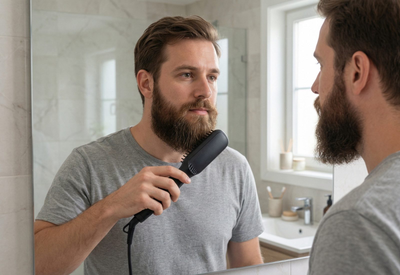
A heated beard straightener is a brush with warm bristles or a warm plate that you run through the beard to straighten waves and kinks for the day. It works on the weak hydrogen bonds inside each hair: heat breaks them, and as the hair cools they form again in the shape the brush left. The dermatologist Paradi Mirmirani described the same mechanism for flat irons at an American Academy of Dermatology meeting. Water breaks those bonds as well, so a heat-set shape lasts only until the hair gets wet again or meets humid air, as chemists at the University of Virginia and Smithsonian magazine both explain. Expect the effect to hold until the next wash or the first rain on Khreshchatyk. The brush changes how the hair lies and leaves its length alone. If your unruly beard points in all directions after a shower, that is a styling problem, and a heated brush can help with it. If one cheek has grown visibly longer than the other, that is a length problem, and a trim solves it.
Dry it, protect it and keep the setting low
Start with a clean, dry beard. The American Academy of Dermatology (AAD) says flat irons belong on dry hair only, and medical case reports describe bubble hair: heat turns the water inside a wet hair shaft into steam, leaves it full of cavities and makes it break. DermNet lists straightening irons among the triggers. After the shower, pat the beard with a towel and let it dry, or finish it with a dryer. Next comes a heat protectant, which dermatologists at the AAD, Cleveland Clinic and Baylor College of Medicine all advise. Pick the lowest temperature that works. The AAD recommends a low or medium setting, and Dr Mirmirani put the ceiling for flat irons at 175 °C. Brush in short, steady strokes and keep the brush moving, since the AAD advises limiting how long a hot tool touches the hair. Take the cheeks downwards, the chin straight down, then the front and the moustache. Keep the hot bristles off the skin of your neck, and leave the brush to cool where nobody will grab it: in burns studies, hair straighteners stayed hot enough to burn skin for several minutes after switch-off. At 044 Barbershop in Kyiv a beard trim means modelling plus a dry or hot-towel shave, so ask the barber which way your beard grows on the cheeks before you plan your strokes.
When balm or a blow-dryer can do the job instead
How often you use heat matters as much as how hot it is. "No matter your hair type, excessive heat can damage your hair," the AAD warns, and it advises using a flat iron no more often than every other day. Damaged hair turns dry and brittle and breaks. Save the brush for the days your beard fights back and try a gentler routine on the rest. Beard oil softens the hair, and a beard balm worked through with a comb holds it in the direction you press it; grooming guides also put a little balm on after the brush to settle stray hairs. The other option is a blow-dryer. The AAD recommends its lowest heat setting, and a laboratory study in a dermatology journal found that drying from 15 cm with the dryer kept moving did less damage to the hair surface than air drying. Point the airflow downwards and comb the beard into shape as it dries. No brush replaces the shape a barber cuts: to keep the outline even, come in every one to two weeks. Bring your straightener questions to the chair, and the barber will show you where your beard needs heat and where it only needs a trim.