The Barber's Chair as Therapy: Men's Mental Health in 2026
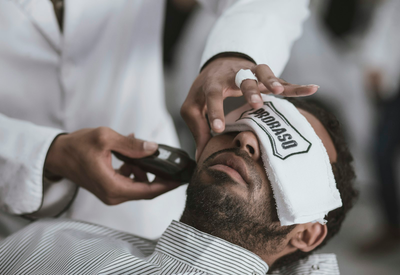
Why men say things in the chair they never say at home
Any barber with a few years behind the chair will tell you the same thing: people talk in that chair, and they talk about real things. Divorce, a diagnosis, losing a job, a draft notice, six months of not sleeping. It is not because barbers are unusually good company. The reason is in the structure of the situation itself. First, you sit beside each other rather than opposite: there is no direct eye contact, which removes half the tension familiar to anyone who has been asked to have a serious talk. Second, another person's hands in your hair is physical contact with no social subtext, a rare thing in an adult man's life. Third, there is a clear timer: the conversation ends when the haircut ends, and you are not obliged to continue anything. Fourth, the barber does not enter your life — he will not tell your wife, will not meet you at work, will not judge you at a family dinner. Sociologists call this a neutral witness. In Ukraine, where many men were still raised to believe that complaining equals weakness and that seeing a psychologist is something other people do, the barber's chair is often the first place where anything is said out loud at all. Sometimes it is the only such place in a month.
A barber is not a therapist, and both sides must know it
And here is the most important part, said plainly: a barber is not a therapist. We have no training, no supervision, no right to make recommendations about a person's state, and we do not always understand what we are hearing. A conversation in the chair can relieve pressure, but it does not treat depression, does not work with PTSD, and does not replace a professional. The worst thing a barber can do is start playing a role he is not prepared for: giving advice, offering diagnoses, retelling other people's stories. A good barber does three things. He listens without interrupting and without turning the conversation to himself. He does not evaluate — no it could be worse, no my friend had it much harder. And if he hears something genuinely alarming, he calmly mentions that there are people who do this professionally, without pressure and without drama. In Ukraine in 2026, access to free psychological support is considerably better than it was a few years ago: there are state programmes, helplines, veteran services. Simply naming that fact in conversation is already a useful act. One more thing that is rarely said: many men come to the chair specifically to be quiet. A barber's ability to read that and not fill the silence with chatter is as much part of the craft as a clean fade.
The grooming ritual as a way of taking back some control
There is a second part to this story, less obvious than the conversation, and it concerns the procedure itself. Looking after yourself is a controllable action in a life where controllable things are getting scarce. You cannot influence the outage schedule, the news, the exchange rate, or when any of it ends. But you can decide what your head will look like, arrive at a specific time, sit in a specific chair, and get a predictable result in forty minutes. Psychologists call this behavioural activation: a small completed action restores a sense of agency, which is exactly why basic self-care appears in every protocol for working with depressive states. This is not about vanity. A man who has stopped shaving and stopped getting his hair cut often shows the first symptom of his condition right here, and the people close to him notice it before anything else. That is why a regular barber appointment you put in the calendar as a fixture, rather than as something you will get around to, works as a small anchor. We have seen it many times: a client who disappeared for six months comes back, sits down, and says that coming here was the first thing he did once it got easier. A haircut solves nothing by itself. But it is a good action to start from, and that is worth respecting.