Shaving Against the Grain: Is It Ever a Good Idea?
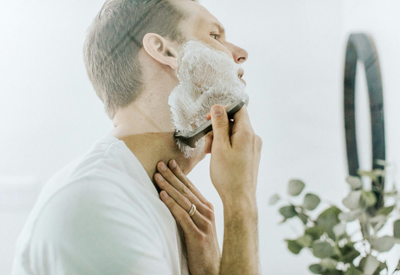
Is shaving against the grain actually bad?
You can shave against the grain, but dermatologists do not recommend it as the default, and on the neck it tends to backfire. The American Academy of Dermatology tells people to shave in the direction the hair grows, and the NHS gives the same advice for avoiding ingrown hairs. Shaving guides name three directions: with the grain follows the lie of the hair, across the grain crosses it at right angles, and against the grain runs opposite to it. Against the grain gives the closest result because the blade meets the hair head on and cuts it short. That is also the catch. DermNet notes that after a close shave the pointed tip of a cut hair may re-enter the skin, most often when the hair is coarse and tightly curled. The 2019 review in Clinical, Cosmetic and Investigational Dermatology describes a second route: after a close shave the sharp tip can grow sideways and pierce the skin a few millimetres from its own follicle. Men with straight, soft hair on flat cheeks often take an against-the-grain pass and feel nothing. Men with curly or wiry hair, or a neck full of swirls, pay for it two days later in small red bumps. So ask the question about one patch of face at a time. Cheeks and upper lip sometimes tolerate it. Under the jaw and on the neck, leave it alone, and if your skin has a history of bumps, skip it everywhere.
Why the neck punishes the wrong direction
Before you pick a direction, find out which way your hair lies. The AAD suggests looking in a mirror and pulling the skin tight where the hair grows to see how it lies; a hand run over the cheek works too, and wherever you meet resistance is against the grain. Gillette's guides add a warning: neck hair grows in several directions, so one downward stroke cuts part of it against the grain without you meaning to. That matches what barbers often see at the chair. Clients often say their neck grows straight down, and then the hair under the jaw turns out to point sideways. On many men the cheeks follow one lie, while under the chin and at the nape the hair swirls, and a shaved head has its whorl at the crown. The line where the direction flips can be only a couple of centimetres wide. At 044 Barbershop in Kyiv a hot-towel shave usually starts from how your hair lies, and the barber can tell you which patch can take a second pass and which cannot. If your hair grows in mixed directions, the AAD says gently brushing it daily with a toothbrush can train it to lie one way. Then build the passes. Go with the grain first. If you want it closer, apply fresh foam and go across the grain. Keep a pass against the grain for the cheeks only, and only if your skin handled the first two without redness.
Map your own growth before the next shave
If you want a closer finish without the bumps, direction is only one lever. The NHS advises leaving at least 1 mm of stubble and using as few strokes as possible, and DermNet adds that you should not stretch the skin or go over the same area twice. DermNet also links shaving bumps more with blade razors than with electric shavers, and the same review reports that electric clippers are associated with fewer cases and recommends leaving at least 1 mm of hair. DermNet suggests shaving less often too, for example every other day. It calls stopping shaving altogether the safest cure, with symptoms usually settling about four to six weeks later. The NHS adds that waxing, plucking and threading can cause ingrown hairs too, so putting the razor down does not remove the risk. If bumps keep coming back although you shave only with the grain, the cause may be the curl of the hair itself, a condition doctors call pseudofolliculitis barbae, and the AAD advises seeing a board-certified dermatologist. The NHS lists a hot, very painful or swollen area, or a high temperature, as reasons to see a GP. Come to us for a face or head shave with a hot towel: the barber sees your nape and the back of your jaw from behind and can show you where your hair turns.