Shavette for beginners: loading the blade and shaving without cuts
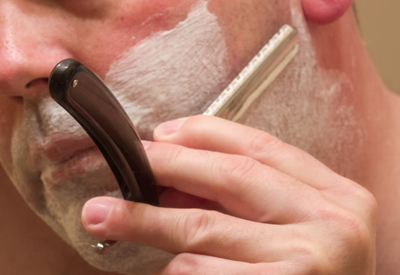
What does a shavette do differently from a cut-throat?
The box holds a steel handle, a clamp and a pack of blades, and nothing else: no blade in the razor, no leather strop, no stone. That is a shavette, a straight razor built around a replaceable blade, usually one half of an ordinary double-edge blade from a classic safety razor. A folding straight razor, the cut-throat, carries a fixed steel blade that you strop on leather before each shave and send for honing once it dulls. The shavette skips both, since a dull blade goes in the bin and a fresh one takes its place. That makes it the cheaper way to find out whether you like shaving with an open blade. The blade itself behaves differently, which surprises men who expected a gentler start. A half blade is thin, flexible and shorter than a cut-throat's edge, and shaving guides and forums describe it as less forgiving: it bites at once if the angle goes too steep or the hand presses. A honed steel razor has more weight and a stiffer edge, so it warns you of a mistake a moment earlier. Barbers often see the result on a beginner's face as a row of small nicks along the jaw, where the corner of the blade catches as the hand turns. Treat the first week as practice on the cheeks and the sides of the neck, and leave the upper lip and chin to your usual razor until the stroke feels natural.
The first shaves go slowly, with the grain and almost no pressure
Load the blade while your hands are dry. If the pack holds whole double-edge blades, snap one in half lengthwise inside its paper wrapper, so your fingers never touch the edges; pre-split half blades save that step and usually seat straighter. Open the clamp, slide the half blade in by its blunt ends, close it and look along the edge: the blade should sit parallel, with the same narrow strip showing from end to end. A crooked blade cuts deeper at one corner. Then prepare the beard as you would for any blade. The American Academy of Dermatology (AAD) advises wetting the skin and hair first, calls the time right after a shower a good one, and then recommends a shaving cream or gel. To find the angle, lay the blade flat on your cheek and lift the spine to about 30 degrees, the figure that guides from several shavette makers agree on. Steeper, it scrapes and nicks; flatter, it glides over the stubble. Pull the skin taut with your free hand, take short strokes and let the weight of the razor do the cutting. The first pass goes with the grain, the direction the AAD recommends to prevent razor bumps and burns, and for a beginner one pass is enough. At 044 Barbershop in Kyiv a face or head shave with a hot towel is a service of its own, and in the chair you feel on your own skin how light a good stroke of the blade is.
Change the blade often and never lend the razor
Rinse the blade after every stroke, as the AAD advises for any razor, and when you finish, open the clamp, rinse the holder and let both parts dry completely. The same AAD page warns against leaving a razor on a wet sink, where bacteria can grow on it. A half blade dulls quickly. The AAD's general rule is a new blade after five to seven shaves, and with a shavette many men change it sooner, as soon as it starts to tug at the hair, because a dull edge needs pressure and pressure is where cuts come from. Never lend your shavette or borrow one, even with a fresh blade in the holder: the NHS lists sharing razors among the ways hepatitis C passes on through traces of blood. A used blade never goes loose into the bin. Drop it into a blade bank or a closed tin with a slot, or fold it back into its paper wrapper and tape it, so nobody taking out the rubbish gets cut. Keep to one pass with the grain until a whole week goes by without a drop of blood, and only then try a second pass across. Neck lines and stubble lose their shape fast, so barbers recommend a shave or beard tidy in the chair every one to two weeks. Come in for a hot-towel shave, and from the chair you can watch the angle of the blade and the free hand stretching your skin, the two things a beginner takes longest to learn.