A Child's First Barbershop Visit: A Guide for Parents
What age to start, and why age is not the real question
Parents ask about age first, and that is not quite the right question. Technically a child can be cut from the moment they hold their head up steadily, and plenty come in before their first birthday. What matters is not the number but three specific abilities: can the child stay in one place for ten minutes, do they cope with a loud noise, and do they respond to a simple request like look down for me. Some have all three at eighteen months, others at four. A child who sits calmly in a dentist's chair usually settles into ours without trouble. A child who screams at the vacuum cleaner at home will probably be frightened by clippers, and that is normal: clippers are not only loud, they vibrate, and the vibration travels through the skull and sounds far louder inside the head than it does from the outside. For those children we cut entirely with scissors — it takes longer, but nobody cries. One more thing about a true first time: if you have already cut their hair at home and it turned into a fight, tell the barber straight away. We will work differently, from another angle, slower, with a longer introduction. A child does not remember the details, but remembers the feeling very well, and our job is to overwrite that feeling rather than repeat it. And if the child has already been in the room while we cut their father, the first time stops being a true first time, and that shows within the first thirty seconds.
How to prepare at home: three things that actually work
Preparation at home decides more than anything that happens in the chair. First: do not promise it will not be scary or ticklish. A child will test that promise within thirty seconds, and if it fails, trust is gone for the rest of the visit. Say it plainly instead: there will be noise, it will tickle a bit near the ears, some hair may land on your nose. Second: show them the process in advance. The simplest way is to bring your child along to your own haircut a week before theirs. They see dad sitting in the chair, nothing bad happening, the barber talking in a normal voice, and then dad standing up in one piece and pleased with himself. That works better than any cartoon about a barbershop. Third: timing. Book a morning slot, in the first hours of the day. After nursery or school a child has already spent the whole reserve of patience; at ten in the morning it is still full. The shop is quieter then too, fewer people, fewer clippers running at once. Do not plan anything else important for that day and do not arrive five minutes before the appointment: let the child walk around the floor, look at the chairs, hold a brush. Ten minutes of acclimatising saves half an hour of tears. And feed them before you leave the house, because a hungry child sits still nowhere.
What a barber does when a child cries, and when we stop
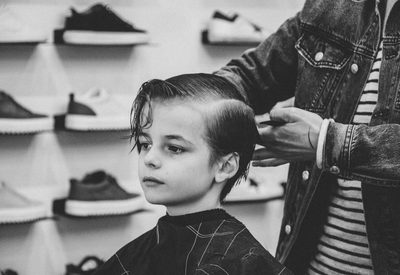
Now for what happens on our side of the chair. We do not start with scissors. The child sits down first, often on a parent's lap rather than alone, and that is fine, we cut like that all the time. The barber lets them hold the clippers switched off, turns them on in the child's own hand so they feel the vibration first, and only then brings them near the head. We begin at the back rather than the face, so the child does not watch a tool approaching. We often skip the cape altogether: for small children it is scarier than the haircut. The talking never stops for a second, and that is not small talk, it is a tool — while a child is answering, they are not analysing the noise. If crying starts anyway, we pause rather than speed up. Speeding up is the classic mistake: the barber hurries to finish, the child feels the adult's tension and escalates. Sometimes we stop halfway and agree to come back in three days. A half-cut child who left calm will come back and let us finish. A child who was held down and finished by force will be afraid of the chair for another five years. This is the hardest moment for parents, because you want to see the job through, but the long game wins here. And yes, we wrap the first lock in paper and hand it to you — one of the few things no parent has ever regretted taking home. And come back in a month even if there is almost nothing to cut. The second and third haircuts build the habit, and after them the chair stops being an event.