Hair and Beard in Winter: What to Change for the Cold Months
What cold and dry indoor air actually do to your hair
Winter hair problems are rarely caused by frost as such. The real culprit is the swing in humidity. Outside at minus five the air holds very little water; indoors with central heating the relative humidity drops to around twenty per cent, which is drier than a desert. A hair behaves like a sponge, gives its moisture up to the room, turns stiffer, bends worse and snaps where it used to simply bend. The scalp reacts faster than the hair does: it feels tight, it itches, and it flakes in a way many men mistake for dandruff and start treating with aggressive anti-dandruff shampoo. That makes things worse, because real dandruff is fungal while winter flaking is dehydration. Add the hot shower that feels like salvation after a cold street but strips the protective lipid layer quicker than anything else. And there is one more winter factor nobody thinks about: sharp temperature swings. Walking from the frost into a warm room coats the hair in micro-condensation that then dries off fast. One such cycle changes nothing, but sixty of them across a season show up on your ends very clearly. There is also a simple thing that undoes a whole winter of care: leaving the house with wet hair. Water inside the strand freezes and expands, and that damage is mechanical rather than gradual. If you wash in the morning, build twenty minutes of drying time into the schedule or move the wash to the evening.
Hats, static and a beard in the wind: practical answers
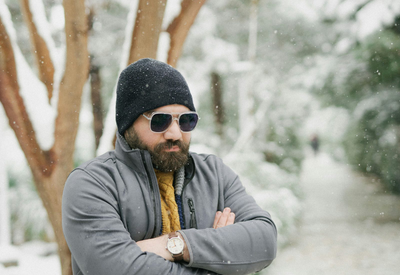
The hat gets blamed unfairly: winter without one is worse than winter with one. The question is the material and what you do afterwards. Coarse wool against bare hair creates friction and static, so a lined hat or a softer yarn solves half the problem immediately. Never put a hat on damp hair: the strand is at its most vulnerable then, and in freezing air the water inside it literally expands. Static is not fixed by a comb but by moisture — a few drops of light oil spread through the lengths beat any anti-static trick. A beard suffers more in winter than the hair on your head, because it is fully exposed to the wind with no protection over the skin beneath it. Wind pulls water out of the hairs and out of that skin, which is the source of the winter itch men usually blame on a beard that is growing in. Beard oil in winter is not optional but basic, and it belongs on the skin rather than on the ends. A balm or wax adds a film on top that holds the moisture in, and at minus ten you feel the difference. Two more winter details. A scarf pulled up over the beard traps damp breath against the hair, and that constant wet-dry cycle does more harm than the cold itself, so drop it below the chin indoors and in transit. And take the hat off as soon as you are inside: a warm scalp under wool sweats, and that sweat is what actually leaves hair flat and greasy by midday.
The winter schedule: washing, products and barber visits
A winter routine differs from a summer one in three places. First, how often and how hot you wash. Cut one wash a week and make the water warm rather than hot: a few degrees changes how much lipid stays on your skin. Second, the products. Matte clays and powders dry hair further in winter, so replace them at least partly with creams, water-based pastes or a classic pomade. If you will not give up the clay, put a little leave-in conditioner underneath it. A humidifier in the bedroom is the cheapest and most effective investment in winter hair that exists, and it works equally on hair, skin and throat. Third, the visits themselves. Hair breaks at the ends more often in the cold, so this is not the season to stretch the interval between cuts: an end that has been trimmed does not keep splitting upward. A beard also needs shaping more regularly, because dry hair sticks out and the shape falls apart faster. At 044 Barbershop we offer the hot towel treatment more often in winter, and that is not ritual for its own sake but the simplest way to bring a scalp back to normal after a few weeks of radiators. And do not panic at seasonal shedding. Slightly more hair in the drain between autumn and early winter is a normal cycle that settles by spring; what is not normal is a scalp that stays red, weeps or flakes in thick plaques, and that belongs to a dermatologist rather than to a new shampoo.