Skipper beard: what the name means, with or without moustache
Why the name needs a description
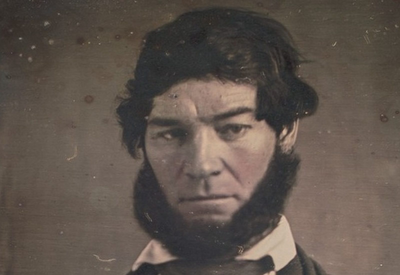
Ask for a skipper beard in a barber's chair and you may well get a follow-up question. The name is regional and has no fixed international meaning: in English the closest terms are chin curtain or a wide chinstrap. One Ukrainian barbering guide describes a skipper beard as a line along the jaw and chin from sideburn to sideburn, with no moustache and a length of roughly 1 to 3 cm. So ask by description and add the name afterwards. A chinstrap is a narrow band, while a chin curtain runs wider and longer, and the simplest way past the confusion is to say how wide you want your band. The family has a historical name as well, the Shenandoah. Abraham Lincoln wore a beard with a bare upper lip, and Amish men still shave the moustache, which they long associated with the military. The seafaring link in the name rests on tradition, as we could find no documented origin, so treat the captain with a pipe as a legend. In practice the style frames the face and leaves the cheeks and lip open, so you never have to grow a full beard. It also leaves the face very exposed, and everything a moustache used to hide is now on show. That makes the first look in the mirror a surprise for many men. Give yourself a few days to get used to it before you judge the result.
Does a skipper beard come with a moustache?
The classic version has no moustache, and that absence creates its unusual look. Add a moustache and you get a narrow jawline beard with shaved cheeks: a perfectly usable shape, although not everyone will recognise it as a skipper, so again ask by description. Let your upper lip decide. If it is long or you find it strange to see it bare, try it for a few days before settling, since a moustache takes a while to grow back. Guides agree that the style suits oval faces. They disagree on round and square faces and weak chins, and some barbers suggest a wide, short band for long faces, so that decision belongs to the mirror. Barbers usually pay attention to two lines, on the cheek and on the neck. Raise the cheek line too far and the band stops working as a frame. Set the neck line right on the edge of the jaw and the head looks cropped from below. At 044 Barbershop in Kyiv a beard trim combines modelling with a dry or hot-towel shave, so the bare cheeks, neck and lip come out clean. The shape is cut from what has already grown, so avoid tidying the beard yourself before the visit, because any hair you take off the band beforehand limits how wide it can be. Tell the barber whether you plan to keep the band or are only trying it, as that decides how boldly the cheeks come off.
How to keep the lines at home
Home care is simple but regular. Shave the upper lip daily or every day or two, because dark stubble above the lip turns a skipper into plain neglect in no time, and the moustache is always the first thing to creep back. Do the cheeks and neck at the same session to keep the outline sharp, and use a side mirror, since a wobble in the line barely shows from the front. A common home error is taking a little more off the neck each time until the line reaches the jaw itself. Another is raising the cheek line again and again to correct a crooked end. Leave a small flaw for a few days instead of losing band width you cannot get back in an evening. Keep the band the same length on both sides so the face does not look lopsided, and blend it smoothly into the sideburn near the ear. Comb the band downwards before you shave, so you can see where its real edge lies. To stop the lines from blurring, come in for a beard trim every one to two weeks. Shaving the lip and cheeks at home does not replace that, because the outline and its symmetry from the side and behind only show to another pair of eyes. Come to us with the beard grown out, tell us how wide you want the band, and the barber will draw one line from ear to ear that matches on both sides.