Brows, ears and nose: the details everyone notices except you
Why these hairs start living a life of their own after thirty-five
A man can have a perfect fade and a well-kept beard, and the whole look still falls apart because of three hairs sticking out of one ear. This is not a question of being careless: after thirty-five the hormonal balance shifts, and the follicles in the nose, ears and brows become more sensitive to androgens. The hair on top of your head may be thinning in exactly the same period while these hairs do the opposite, growing thicker, darker and longer because their growth phase stretches out. The phenomenon has a name, androgenic hypertrichosis, and it is entirely normal, but nobody warns you about it in advance. Brows thicken unevenly: single hairs grow twice the length of their neighbours and start curling upwards. Ear hair appears on the tragus and along the lobe, nose hair grows towards the rim of the nostril where side light catches it. The sneaky part is that in the morning mirror you look at yourself head-on and up close, while everyone else sees you in profile, from a distance, in daylight. That is exactly why a barber usually spots these details before the owner does. Add one more factor: hairs in these zones grow at different speeds, so it is never the whole brow that goes wild, just one or two hairs, which is why the problem seems to appear overnight between two visits to the barber. Spotting it yourself is harder still because your eye adapts to your own face faster than to any other.
What a barber does, and why he never draws a line
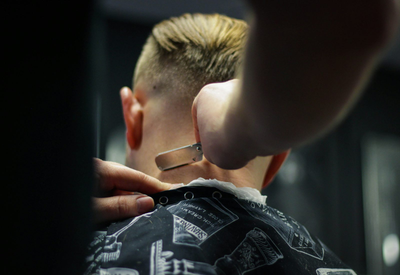
In a barbershop these zones are part of the haircut by default and take about five minutes at the end of the session. A barber does not draw your brows into a line and does not thin them out: a man's brow should keep its natural shape and density. The work is something else, removing the individual long hairs that break out of the mass, shortening them with scissors over a comb, and taking out the stray hairs between the brows and on the bridge of the nose. The key word is shorten, not pluck: pull hairs out by the root often enough and the brow thins over time, leaving a hard line that looks borrowed from someone else's face. Ears are handled with a guarded trimmer or, in the classic technique, a quick pass of flame or a hot towel, depending on which school the barber comes from. The nose gets a shielded trimmer and nothing else, ever. A barber also watches the proportions: with tidy brows and a clean temple line, the same haircut simply looks more expensive. If you have never asked for this specifically, just mention it in the chair; it is part of the job, not an extra. If you are sitting in a new chair, set the limits out loud at the start: natural shape, take off only what is long. A barber works fast and defaults to whatever his school considers normal, and schools differ, with some cleaning a brow up far more aggressively than you would like. One sentence at the beginning saves you a month of growing it back.
Home tools and the safety rules that matter
At home you need three things: a shielded trimmer for nose and ears, small scissors with rounded tips, and tweezers for the occasional stray. Never pull nose hair out. The lining in there is tightly connected to the blood supply of the face, and a torn follicle gets infected easily; the same reasoning rules out unguarded scissors and wax strips. Nose hair works as a filter, so you shorten it level with the rim of the nostril rather than clearing it out at the root. Brush your brows upwards with a small brush, trim whatever sticks out past the natural contour, and then stop. The rule is simple: if you are wondering whether to remove a hair, leave it. Tweezers are for the space between the brows only, one hair at a time, looking into a mirror at arm's length rather than a magnifying one. Ears are easiest to inspect with your phone on selfie mode in daylight. Once every two weeks, five minutes, and this is the part of grooming where consistency counts for more than skill. And there is the tool hygiene almost everyone forgets: rinse the trimmer guard after every use and wipe it with alcohol once a week, clean the scissors after every brow trim and the tweezers every single time. A nose trimmer is not lent to anyone, not even at home, and its blades get replaced about twice a year, because a blunt guard does not cut hair, it yanks it out.